When John Sage purchased the Aurora site in 1996, the challenge was clear—deliver a standard apartment building or create a distinctive residential landmark that would stand apart in both design and quality.
Designing Homes with Purpose
Aurora represents a living environment where residents connect, relax, and express who they are. A thoughtfully designed home contributes to comfort, wellbeing, and a sense of identity.
Aurora represents a living environment where residents connect, relax, and express who they are. A thoughtfully designed home contributes to comfort, wellbeing, and a sense of identity.
The site was acquired on 22 October 1996, during a cautious period for residential development. Interest rate pressures had recently impacted the market, and St Kilda Road remained predominantly commercial in nature.
Once ownership was secured, the development strategy focused on quality rather than cost-cutting. John Sage believed the location deserved an elevated architectural response.
At the time, many apartment projects prioritised efficiency over individuality, producing uniform and uninspired buildings. This approach was rejected in favour of something more refined.
Collaborating with Nigel Fitton proved pivotal. Together, they envisioned a building that would be both architecturally striking and deeply liveable.
Balconies were designed as functional outdoor spaces, integrated into the building structure rather than appended externally.
Aurora’s centralised air-conditioning system further enhances comfort while maintaining a clean architectural aesthetic. Every element works together to improve the living experience.
Construction methodology played a critical role in achieving this outcome.
A Commercial Construction Advantage
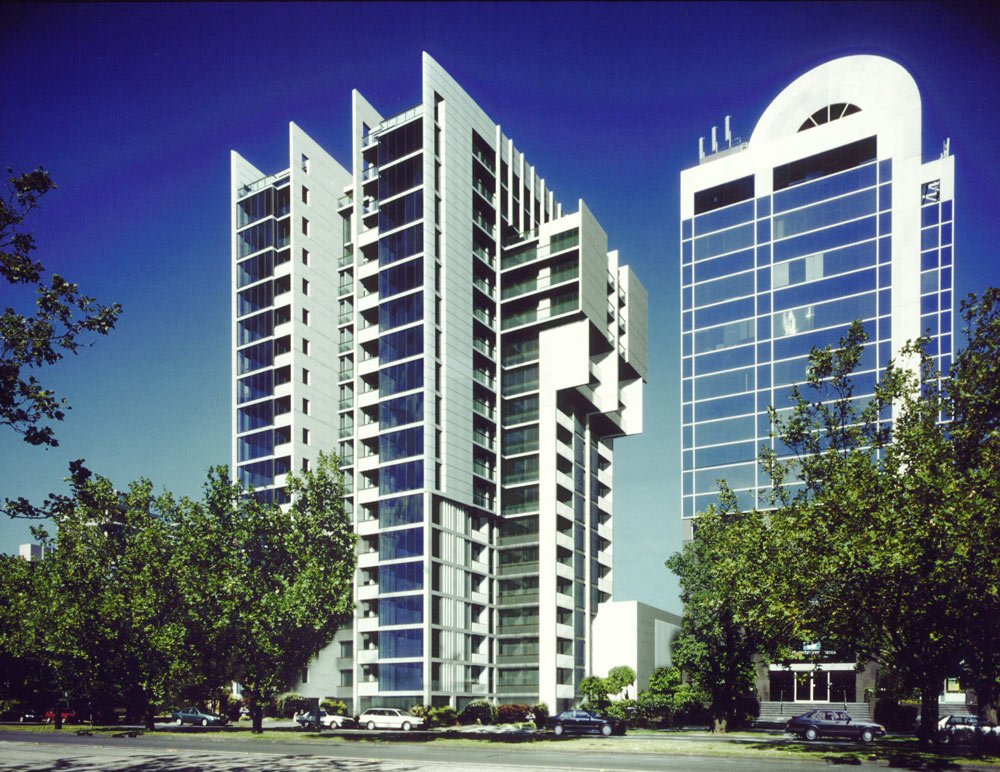
Tilt-slab construction often restricts design flexibility. Aurora instead required an approach that allowed for spacious interiors and diverse layouts.
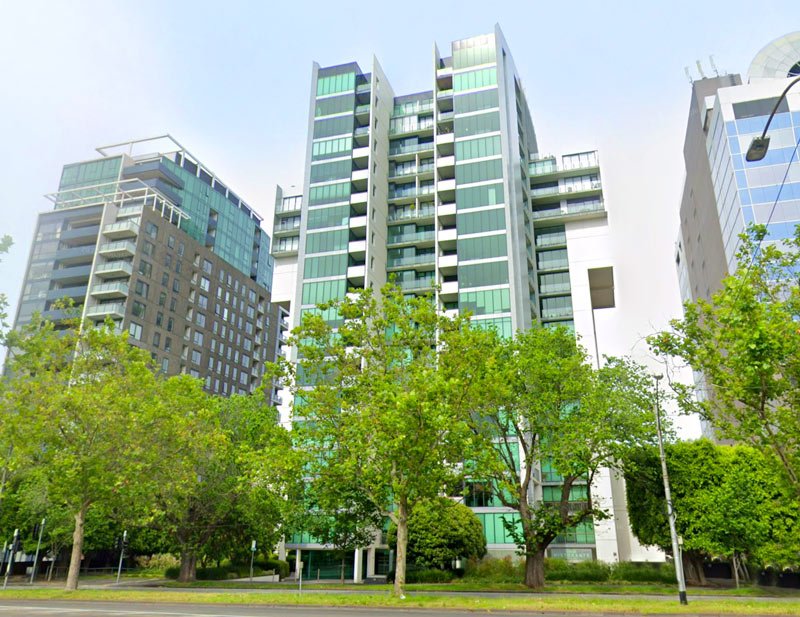
An open-engineered commercial system was chosen, enabling larger rooms, expansive windows, and a variety of apartment configurations.
This structure also supported the building’s distinctive form and improved the relationship between internal spaces and external views.
Aurora’s reduced floor count allowed for higher ceilings, delivering a sense of openness that distinguishes it from surrounding developments.